Up to now our sidebar included the names of blogs that linked to The Sociology of Information. Now that the field has started to achieve something of a latent critical mass out there, I'm evolving the blog roll in the direction of "other blogs on the topic" which is really more useful.
First entry is Drew Conway's Zero Intelligent Agents blog. Drew is a PhD student in political science at New York University who studies terrorism and armed conflict using tools from mathematics and computer science. Much of the material on the blog is more on the techie side of things (it's an extremely useful resource in this regard) but interspersed with news about python routines and R utilities is much grist for the sociologist of information's mill.
Tuesday, May 10, 2011


Tuesday, May 03, 2011
Toward a Wikipedia of Sociology
Every few years one gets a request from the editor of an encyclopedia of social theory or globalization or social research. Some publisher has succumbed to the idea that a new compendium is needed and some senior scholar has succumbed to the idea that "the time has come...." Or, some senior scholar has managed to cajole some junior scholar into doing most of the work on a project that will bear the senior scholar's name. OK, that last might be a little harsh. What's next is someone conjures up a list of usual suspects (or, more likely, a series of database searches produces such a list). Then someone sets up a content management system and an editor at the publisher solicits articles on behalf of the senior scholar editor -- usually with promise of a complimentary copy of the finished volume(s) as an honorarium
I wonder, though, if the days of this genre are numbered. Would it not make sense to create an encyclopedia of sociology for and by card-carrying sociologists? Mightn't crowd-sourcing disciplinary knowledge be superior to the limited intellectual resources represented by centrally selected article authors and the limited review of a small handful of editors? I mean, the typical encyclopedia article probably has fewer peer reviews than most articles get.
What if a professional association opened up a wiki with a single restriction: you have to be a member to edit and you have to edit under your own identity. Beyond that, no central control.
To be realistic, this is probably much more openness and flexibility than most professional associations could ever tolerate. There'd have to be a committee of members and probably a report to the executive committee or something like that that would turn the endeavor into as close a clone of the traditional encyclopedia as possible.
So, maybe what has to happen is that the project has to start with a small group of renegades. And so, just by way of testing the waters, that's what I am proposing.
You sociologists out there, are you game?
I wonder, though, if the days of this genre are numbered. Would it not make sense to create an encyclopedia of sociology for and by card-carrying sociologists? Mightn't crowd-sourcing disciplinary knowledge be superior to the limited intellectual resources represented by centrally selected article authors and the limited review of a small handful of editors? I mean, the typical encyclopedia article probably has fewer peer reviews than most articles get.
What if a professional association opened up a wiki with a single restriction: you have to be a member to edit and you have to edit under your own identity. Beyond that, no central control.
To be realistic, this is probably much more openness and flexibility than most professional associations could ever tolerate. There'd have to be a committee of members and probably a report to the executive committee or something like that that would turn the endeavor into as close a clone of the traditional encyclopedia as possible.
So, maybe what has to happen is that the project has to start with a small group of renegades. And so, just by way of testing the waters, that's what I am proposing.
You sociologists out there, are you game?
Tuesday, April 26, 2011
Reinventing Research? Information Practices in the Humanities
[re-blogged from Resource Connection : April 26, 2011]
A project of the Research Information Network (RIN) focuses on the behaviours and needs of researchers working in the humanities.The goal of RIN study is to:
The report is based on interviews and focus groups with academics responsible for digital humanities projects such as Old Bailey Online, Digital Image Archive of Medieval Music, and The Digital Republic of Letters, projects they've arrayed in a two dimensional attribute space defined by computational complexity and collaborative complexity:
 The report is available to download from Information use: case studies in the humanities - Report
A project of the Research Information Network (RIN) focuses on the behaviours and needs of researchers working in the humanities.The goal of RIN study is to:
- "develop an in-depth understanding of humanities researchers’ approaches to discovering, accessing, analysing, managing, creating, refining and disseminating information resources;
- "provide comparisons between the behaviours and needs of researchers in different subjects/disciplines, research teams or institutional contexts;
- "identify barriers to more effective performance in using, creating, managing and exchanging information resources, and suggest how they might be overcome."
The report is based on interviews and focus groups with academics responsible for digital humanities projects such as Old Bailey Online, Digital Image Archive of Medieval Music, and The Digital Republic of Letters, projects they've arrayed in a two dimensional attribute space defined by computational complexity and collaborative complexity:

Friday, April 22, 2011
No Such Thing as Evanescent Data
Pretty good coverage of the "iphone keeps track of where you've been" story in today's NYT "Inquiries Grow Over Apple’s Data Collection Practices" and in David Pogue's column yesterday ("Your iPhone Is Tracking You. So What?"). Not surprisingly, devices that have GPS capability (or even just cell tower triangulation capability) write the information down. Given how cheap and plentiful memory is, not surprising that they do so in ink.
This raises a generic issue: evanescent data (information that is detected, perhaps "acted" upon, and then discarded) will become increasingly rare. We should not be surprised that our machines rarely allow information to evaporate and it is important to note that this is not the same as saying that any particular big brother (or sister) is watching. Like their human counterparts, a machine that can "pay attention" is likely to remember -- if my iPhone always know where it is, why wouldn't it remember where it's been?
It's the opposite of provenience that matters -- not where the information came from but where it might go to. Behavior always leaves traces -- what varies is the degree to which the trace can be tied to its "author" and how easy or difficult it is to collect the traces and observe or extract patterns they may contain. These reports suggest that the data has always been there, but was relatively difficult to access. It's only recently that, ironically, due to the work of the computer scientists who "outed" Apple, that there is an easy way to get at the information.
Setting aside the issue of nefarious intentions, we are reminded of the time-space work of the human geographers such as Nigel Thrift and Tommy Carlstein who did small scale studies of the space-time movements of people in local communities in the 1980s and since. And, too, we are reminded of the 2008 controversy stirred up when some scientists studying social networks used anonymized cell phone data on 100,000 users in an unnamed country.

Of course, the tracking of one's device is not the same as the tracking of oneself. We can imagine iPhones that travel the world like that garden gnome in Amelie and people being proud not just of their own travels but where there phone has been.
See also
This raises a generic issue: evanescent data (information that is detected, perhaps "acted" upon, and then discarded) will become increasingly rare. We should not be surprised that our machines rarely allow information to evaporate and it is important to note that this is not the same as saying that any particular big brother (or sister) is watching. Like their human counterparts, a machine that can "pay attention" is likely to remember -- if my iPhone always know where it is, why wouldn't it remember where it's been?
It's the opposite of provenience that matters -- not where the information came from but where it might go to. Behavior always leaves traces -- what varies is the degree to which the trace can be tied to its "author" and how easy or difficult it is to collect the traces and observe or extract patterns they may contain. These reports suggest that the data has always been there, but was relatively difficult to access. It's only recently that, ironically, due to the work of the computer scientists who "outed" Apple, that there is an easy way to get at the information.
Setting aside the issue of nefarious intentions, we are reminded of the time-space work of the human geographers such as Nigel Thrift and Tommy Carlstein who did small scale studies of the space-time movements of people in local communities in the 1980s and since. And, too, we are reminded of the 2008 controversy stirred up when some scientists studying social networks used anonymized cell phone data on 100,000 users in an unnamed country.
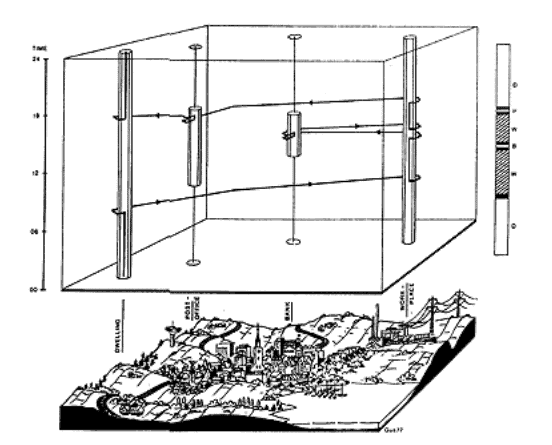
Of course, the tracking of one's device is not the same as the tracking of oneself. We can imagine iPhones that travel the world like that garden gnome in Amelie and people being proud not just of their own travels but where there phone has been.
See also
Data Exhaust and Informational Efficiency
Heard an interesting talk by Paul Kedrosky a few weeks ago at PARC titled Data Exhaust, Ladders, and Search.
The gist of the talk is that human behaviors of all kinds leave traces which constitute latent datasets about that activity. Social scientists have long had a name for gathering this type of data: unobtrusive observation. Perhaps the most famous example is looking at carpet wear in a museum as a way of figuring out which exhibits captured the most visitor attention or garbology and related "trace measures used by anthropologist W. Rathje in the 70s and 80s.
One of Kedrosky's nicer examples was comparing aerial view of Wimbledon center court at the end of a recent tournament with one from the 1970s. The total disappearance of the net game from professional tennis was clearly visible in the wear patterns on the grass court.

In addition to a number of neat examples (ladders found on highways as indicator of housing bubble was a favorite) of using various techniques to capture "data exhaust" (indeed, he suggests, it's the entire principle behind google), he asks the question: What are the consequences of an instrumented planet? That is, a planet on which more and more data exhaust is captured and analyzed, permitting better decisions and more efficient choices.
In fact, one of the comments on Kedrosky's blog post about the talk (by one J Slack) suggests a continuing move toward "informational efficiency" -- with more and more instrumentation generating data and more and more connectivity, he suggests, "we'll be continuously approaching an asymptotic efficiency, though never quite getting there."
A standard definition of informational efficiency is "the speed and accuracy with which prices reflect new information" (TheFreeDictionary.com). But there is some circularity here -- in this context it's only information if it does affect the price, otherwise it's mere noise. And so we're still left with the challenge of sorting out the signal from the noise even after the data has been extracted from the exhaust. And the more of everything the more of a job it is.
Bottom line: I think "data exhaust" is a great concept, but I don't think perfecting its capture and analysis gets you to a fully efficient use of information about the world (even asymptotically). The second law of thermodynamics kicks in along the way for starters, but the boundedness of human cognition finishes the job.
Somebody is probably going to point out that evolution already does this (that is, it's the most unobtrusive data collection method of all). But it takes big numbers and lots of time to do it and the result, though beautiful, is messy.
More to think about here, to be sure.

The gist of the talk is that human behaviors of all kinds leave traces which constitute latent datasets about that activity. Social scientists have long had a name for gathering this type of data: unobtrusive observation. Perhaps the most famous example is looking at carpet wear in a museum as a way of figuring out which exhibits captured the most visitor attention or garbology and related "trace measures used by anthropologist W. Rathje in the 70s and 80s.
One of Kedrosky's nicer examples was comparing aerial view of Wimbledon center court at the end of a recent tournament with one from the 1970s. The total disappearance of the net game from professional tennis was clearly visible in the wear patterns on the grass court.
In fact, one of the comments on Kedrosky's blog post about the talk (by one J Slack) suggests a continuing move toward "informational efficiency" -- with more and more instrumentation generating data and more and more connectivity, he suggests, "we'll be continuously approaching an asymptotic efficiency, though never quite getting there."
A standard definition of informational efficiency is "the speed and accuracy with which prices reflect new information" (TheFreeDictionary.com). But there is some circularity here -- in this context it's only information if it does affect the price, otherwise it's mere noise. And so we're still left with the challenge of sorting out the signal from the noise even after the data has been extracted from the exhaust. And the more of everything the more of a job it is.
Bottom line: I think "data exhaust" is a great concept, but I don't think perfecting its capture and analysis gets you to a fully efficient use of information about the world (even asymptotically). The second law of thermodynamics kicks in along the way for starters, but the boundedness of human cognition finishes the job.
Somebody is probably going to point out that evolution already does this (that is, it's the most unobtrusive data collection method of all). But it takes big numbers and lots of time to do it and the result, though beautiful, is messy.
More to think about here, to be sure.
See Also (2014)
Johnson, Steven. "What a Hundred Million Calls to 311 Reveal About New York." Wired Magazine 11.01.10Sunday, March 06, 2011
radio + internet + letter to your senator = democracy in action
This project, reported by WNYC and npr's On the Media is one of the best uses of web crowd sourcing I've heard about.
They ask listeners across the country to write their senator asking whether s/he placed a particular anonymous hold and then to submit the response. To date they collected 96 written denials and four "it's none of your business!". Step two is to reword the question and have residents of four states pose them in writing. Rather brilliant.
I also love the implicit claim to inequality in the "it is our privilege to keep secrets from our constituents" stance. This is what Gillian and I are writing about in our paper "Democracy and the Information Order."
They ask listeners across the country to write their senator asking whether s/he placed a particular anonymous hold and then to submit the response. To date they collected 96 written denials and four "it's none of your business!". Step two is to reword the question and have residents of four states pose them in writing. Rather brilliant.
I also love the implicit claim to inequality in the "it is our privilege to keep secrets from our constituents" stance. This is what Gillian and I are writing about in our paper "Democracy and the Information Order."
Monday, February 21, 2011
Sociology of Information in the News
A flurry of sociology of information items in today's New York Times:
- "Book Lovers Fear Dim Future for Notes in the Margins" In a digital world, scholars see an uncertain fate for an old and valued practice.
- "Blogs Wane as the Young Drift to Sites Like Twitter" Long-form blogs were once the outlet of choice, but now sites like Facebook, Twitter and Tumblr are favored.
- "TV Industry Taps Social Media to Keep Viewers’ Attention" As more and more people chat on Facebook and Twitter while watching TV, networks are trying to figure out how to capitalize.
- "100 Years Later, the Roll of the Dead in a Factory Fire Is Complete" For the first time, the names of all the victims in the 1911 Triangle Waist Company fire will be read after a researcher’s identification of six unknown victims.
Information and the Humanities
New York Times reporter Patricia Cohen has been on the "ideas and intellectual life" beat for sometime and has recently produced some excellent pieces of potential interest to the sociologist of information:
- A Digital Future for the Founding Fathers." January 30, 2011. The University of Virginia Press is in the process of putting the published papers of Washington, Jefferson, John Adams, James Madison, Alexander Hamilton and Benjamin Franklin on a free Web site.
- "Scholars Recruit Public for Project." December 27, 2010. A project in London is using crowd-sourcing to transcribe 40,000 unpublished manuscripts of the Enlightenment philosopher Jeremy Bentham.
- "In 500 Billion Words, New Window on Culture." December 16, 2010. A Google-backed project allows the frequency of specific words and phrases to be tracked in centuries of books.
- "Digital Keys for Unlocking the Humanities’ Riches." November 16, 2010. Digitally savvy scholars are exploring how technology can enhance understanding of the liberal arts.
- "Analyzing Literature by Words and Numbers." December 3, 2010. A computer-generated process gives scholars a view into Victorian thought.
Tuesday, December 28, 2010
Outflanking "the Human" with Information
Two stories in NYT today about data crunching. One on mapping neuron connections in mice to understand how brains work. The other on using statistics to detect possible cheating on standardized tests.
The brain research takes thin slices of brain tissue and maps connections between neurons in a really BIG (petabyte per mm3) data mining operation. The research is in the infancy stage, but eventually one can imagine having a full circuit diagram of a brain. Interesting implications possibly grasped by either researchers or the articles author:
The second article, "Cheaters Find an Adversary in Technology," reads as a shameful bit of commercial promotion masquerading as journalism, but does usefully illuminate the worldview of the standardized test industry. The story is about a company that uses statistics to detect cheaters. Their algorithms are designed to detect things like similar patterns of wrong answers, changed answers, and big improvements in test scores. If a group of students all misunderstood something in the same way it would look like cheating. And a test taker who "saw the light" at one point and went back and changed several answers will look like a cheater. And the thing we do most in school, attempt to teach people stuff, if successful would lead to big improvements in test scores. But that too, according to the experts, would look like cheating.
There is an arrogance about testers (the gentleman profiled calls himself (unselfconsciously, notes the journalist) "an icon" -- (those who have never heard of him are poorly informed)) that consistently rankles. And their self-promotion as agents of fairness and meritocracy (recall The Big Test) is simple hypocrisy. More problematic, though, is the influence on teaching, learning, and scholarship of a regime that bases its authority and legitimacy on science and objectivity, but that shrouds itself in secrecy and lives OFF rather than FOR education.
Why these two articles together? They suggest a sort of pincer maneuver against "the human" based in information -- on one flank, structure, define the normal brain to a (particular) giant matrix of ones and zeros, while on the other, behavior, treat statistically unusual patterns of activity as morally suspect. "Super Crunching " may be a way of the future, but one might lament the likelihood that it is THE way of the future, crowding out or delegitimizing other forms of inquiry into the human condition. Together, these two articles suggest the imperative of an affirmative complement to our fascination with what we CAN do with information.
Source Mentions and Allusions
The brain research takes thin slices of brain tissue and maps connections between neurons in a really BIG (petabyte per mm3) data mining operation. The research is in the infancy stage, but eventually one can imagine having a full circuit diagram of a brain. Interesting implications possibly grasped by either researchers or the articles author:
Neuroscientists say that a connectome could give them myriad insights about the brain’s function and prove particularly useful in the exploration of mental illness. For the first time, researchers and doctors might be able to determine how someone was wired — quite literally — and compare that picture with “regular” brains.Experts quoted in the article debate whether the research is promising enough to spend millions on. But this comment about defining normal or regular brains is not one of the concerns they mention. What are the informational implications of having a data set that describes the connections of a "normal" person?
The second article, "Cheaters Find an Adversary in Technology," reads as a shameful bit of commercial promotion masquerading as journalism, but does usefully illuminate the worldview of the standardized test industry. The story is about a company that uses statistics to detect cheaters. Their algorithms are designed to detect things like similar patterns of wrong answers, changed answers, and big improvements in test scores. If a group of students all misunderstood something in the same way it would look like cheating. And a test taker who "saw the light" at one point and went back and changed several answers will look like a cheater. And the thing we do most in school, attempt to teach people stuff, if successful would lead to big improvements in test scores. But that too, according to the experts, would look like cheating.
There is an arrogance about testers (the gentleman profiled calls himself (unselfconsciously, notes the journalist) "an icon" -- (those who have never heard of him are poorly informed)) that consistently rankles. And their self-promotion as agents of fairness and meritocracy (recall The Big Test) is simple hypocrisy. More problematic, though, is the influence on teaching, learning, and scholarship of a regime that bases its authority and legitimacy on science and objectivity, but that shrouds itself in secrecy and lives OFF rather than FOR education.
Why these two articles together? They suggest a sort of pincer maneuver against "the human" based in information -- on one flank, structure, define the normal brain to a (particular) giant matrix of ones and zeros, while on the other, behavior, treat statistically unusual patterns of activity as morally suspect. "Super Crunching
" may be a way of the future, but one might lament the likelihood that it is THE way of the future, crowding out or delegitimizing other forms of inquiry into the human condition. Together, these two articles suggest the imperative of an affirmative complement to our fascination with what we CAN do with information.Source Mentions and Allusions
- Ayres, Ian. 2008. Super Crunchers: Why Thinking-By-Numbers is the New Way To Be Smart
- Foucault, Michel. 1995 (1975). Discipline and Punish: The Birth of the Prison
- Gabriel, Trip. 2010. "Cheaters Find an Adversary in Technology." New York Times, December 27, 2010
- Swedberg, Richard. 2000. Max Weber and the idea of economic sociology
- Vance, Ashlee. 2010. "In Pursuit of a Mind Map, Slice by Slice." New York Times, December 27, 2010

Tuesday, December 14, 2010
Wikileaks Mirror Servers Geographic Visualization
A fascinating Google Earth visualization of the wikileaks mirror sites worldwide.
Monday, December 13, 2010
An Interesting Web Book "App"
What reminds you of what? When one reads -- or hears about -- a book, one almost unconsciously make connections -- this book is a little bit like that book. When you tell someone you are interested in some topic s/he will often say, "well, then you should have a look at ...."
I just stumbled across a web resource, http://www.librarything.com/, that implements this as a combination of a personal library catalog and a social network. It allows you, virtually, to surf your own library and connect from books you know to books that are related to it. Users "tag" books creating a interesting way to slice through the database. Try these, for example: sociology, history, philosophy, economics. And it keeps an eye on where a given book is available -- libraries, bookstores, online digital sources, used book networks (like abebooks.com).
When I played around with it looking for books on the sociology of information I got a bookshelf that nearly mirrored my the books in front of me on my study's shelves, but with a few titles I was unfamiliar with :

I just stumbled across a web resource, http://www.librarything.com/, that implements this as a combination of a personal library catalog and a social network. It allows you, virtually, to surf your own library and connect from books you know to books that are related to it. Users "tag" books creating a interesting way to slice through the database. Try these, for example: sociology, history, philosophy, economics. And it keeps an eye on where a given book is available -- libraries, bookstores, online digital sources, used book networks (like abebooks.com).
When I played around with it looking for books on the sociology of information I got a bookshelf that nearly mirrored my the books in front of me on my study's shelves, but with a few titles I was unfamiliar with :

Wednesday, December 08, 2010
Wikileaks Conversation Continues
Interesting piece in NYT blog "The Lede" about online activists' response to credit card companies and PayPal "blacklisting" Wikileaks.
The entry includes the YouTube "manifesto" of the group (or, rather, decentralized network) "Anonymous" that claims to be at the center of this backlash.
The Times Blog gives a list of related posts:
The entry includes the YouTube "manifesto" of the group (or, rather, decentralized network) "Anonymous" that claims to be at the center of this backlash.
The Times Blog gives a list of related posts:
Sunday, December 05, 2010
An Old Idea Wikileaks has Gotten Me Thinking About Again
I have been sitting on a thought experiment for some years now. Well, not exactly sitting on it -- have written a bit about it and teach it in my "sociology of everyday life" class.
It starts from Simmel's observation (in "How is Society Possible?" -- a brilliant essay, BTW) that a starting point for understanding social interaction has to be the recognition that the human condition involves awareness that one can never completely know the mind of the other. No matter how intimate the relationship, there is material held back.
So, imagine this. One day, god gets a funny idea. S/he suddenly makes people's mental content available to those around them. All the fleeting thoughts, the quick little zigs and zags our minds make (making a cake with my mom, talking with her while I washed the dishes about her mother's death, stealing wet cement from that construction site where I smoked my first cigar, Denise my "girlfriend" in seventh grade though I liked Kim better, that pad Thai tonight was tasty if a bit heavy, I can't believe I mistakenly bought 2% milk the other day -- all that between these two sentences and this report highly censored) fully audible to anyone around us. Everyone her own Ulysses. How exactly it would work, I'm not sure -- but imagine that there's some way that the cacophony of it all would be sorted out and we'd be privy to the internal conversations of those around us (and they ours -- and both of us privy to our reactions to what we were hearing).
So, god does this for maybe 15 minutes and then shuts it down. This would I think, have a profound effect on us. God would be amused. But the s/he gets another idea: before heading off to other realms, s/he announces "that was so much fun, I think I'll do it again sometime."
That, I propose, could be the end of social life as we know it.
It starts from Simmel's observation (in "How is Society Possible?" -- a brilliant essay, BTW) that a starting point for understanding social interaction has to be the recognition that the human condition involves awareness that one can never completely know the mind of the other. No matter how intimate the relationship, there is material held back.
So, imagine this. One day, god gets a funny idea. S/he suddenly makes people's mental content available to those around them. All the fleeting thoughts, the quick little zigs and zags our minds make (making a cake with my mom, talking with her while I washed the dishes about her mother's death, stealing wet cement from that construction site where I smoked my first cigar, Denise my "girlfriend" in seventh grade though I liked Kim better, that pad Thai tonight was tasty if a bit heavy, I can't believe I mistakenly bought 2% milk the other day -- all that between these two sentences and this report highly censored) fully audible to anyone around us. Everyone her own Ulysses. How exactly it would work, I'm not sure -- but imagine that there's some way that the cacophony of it all would be sorted out and we'd be privy to the internal conversations of those around us (and they ours -- and both of us privy to our reactions to what we were hearing).
So, god does this for maybe 15 minutes and then shuts it down. This would I think, have a profound effect on us. God would be amused. But the s/he gets another idea: before heading off to other realms, s/he announces "that was so much fun, I think I'll do it again sometime."
That, I propose, could be the end of social life as we know it.
Friday, December 03, 2010
Wikileaks and Protecting Your Sources
In the NYT, Alan Cowell wrote today about reactions among diplomats to the WikiLeaks leaks. In the middle of the story we read:
NOTE: it appears that in a lot of the material that's been put online by media organizations some redaction of source information has been carried out.
A Chinese intellectual, who spoke in return for customary anonymity, said the disclosures had left those like him who had contact with United States diplomats “nervous” about the possibility of exposure and persecution by authorities who have already blocked access in China to the WikiLeaks Web site.I don't want to equate journalistic secrecy with government secrecy, but I'm surprised, as I suggested in a previous post, that there's been no commentary (or at least none I've seen -- anyone have a reference?) on the irony of the secrecy and confidentiality given sources (as above) by the media vs. the ones revealed in the leaks.
NOTE: it appears that in a lot of the material that's been put online by media organizations some redaction of source information has been carried out.
Wednesday, December 01, 2010
FTC Proposes "Do Not Track" Option for Consumer Privacy
The Federal Trade Commission released a preliminary report, "Protecting Consumer Privacy in an Era of Rapid Change," for public comment today. Among other things, it did suggest the "do not track" option for web surfers. Here's the NYT article on the report.
A few weeks ago E. Wyatt and T. Vega wrote of the then forthcoming FTC report on net privacy in "Stage Set for Showdown on Online Privacy" (NYT November 9, 2010):
I'd like to propose, as a thought experiment, a more radical approach. What if we started from the premise that everyone owns her own information. You own you opinions, your attitudes, and the traces your behavior might create. If this information is valuable to another entity, they are free to bid on it. We don't need privacy protections, we just need an infrastructure that will allow for a market for private information to operate.
A website or a retailer can have an offer, right at the front door: if you want to browse here, I want to know your name and take note of what you look at. The consumer, in return, can say, you can watch me, for 5 dollars. Consumers can make money by moving around the net and generating value. The entities who host websites on which behavior turns into information turns into value would also be entitled to a share.
Now take the idea a step further. Suppose rather than selling my information I agree to license it. This time I say, you can watch me for $5 but down the road, if any value accrues to you by virtue of you aggregating my information with that of others, I want a cut. As my information goes upstream, up the aggregation pyramid, it becomes a component in something valuable: I deserve a share.
Of course, we'll be told this is completely impractical. Retailers and other entities would just build in the cost. And the transaction costs would be too high. Maybe. But we've got micro-credits worked out at the level of single click-throughs. I don't think the barriers would be technical.
A few weeks ago E. Wyatt and T. Vega wrote of the then forthcoming FTC report on net privacy in "Stage Set for Showdown on Online Privacy" (NYT November 9, 2010):
"Consumer advocates worry that the competing agendas of economic policy makers in the Obama administration, who want uniform international standards, and federal regulators, who are trying to balance consumer protection and commercial rights, will neglect the interests of people most affected by the privacy policies. “I hope they realize that what is good for consumers is ultimately good for business,” said Susan Grant, director of consumer protection at the Consumer Federation of America."The report contains what look like some good, balanced, and practical guidelines for how consumers and information collecting entities interact on the web and elsewhere.
I'd like to propose, as a thought experiment, a more radical approach. What if we started from the premise that everyone owns her own information. You own you opinions, your attitudes, and the traces your behavior might create. If this information is valuable to another entity, they are free to bid on it. We don't need privacy protections, we just need an infrastructure that will allow for a market for private information to operate.
A website or a retailer can have an offer, right at the front door: if you want to browse here, I want to know your name and take note of what you look at. The consumer, in return, can say, you can watch me, for 5 dollars. Consumers can make money by moving around the net and generating value. The entities who host websites on which behavior turns into information turns into value would also be entitled to a share.
Now take the idea a step further. Suppose rather than selling my information I agree to license it. This time I say, you can watch me for $5 but down the road, if any value accrues to you by virtue of you aggregating my information with that of others, I want a cut. As my information goes upstream, up the aggregation pyramid, it becomes a component in something valuable: I deserve a share.
Of course, we'll be told this is completely impractical. Retailers and other entities would just build in the cost. And the transaction costs would be too high. Maybe. But we've got micro-credits worked out at the level of single click-throughs. I don't think the barriers would be technical.
From Information Superhighway to Information Metrosystem
The new FTC report on consumer privacy has an interesting graphic in an appendix. It purports to be a model of the "Personal Data Ecosystem." It's interesting as an attempt to portray a four-mode network : individuals, data collectors, data brokers, and data users. The iconography here seems to be derived from classic designs of subway and underground maps.
The genre mixing in the diagram invites, on the one hand, a critical look at where the FTC is coming from in the report (which, in my limited experience of digesting FTC output looks relatively well done) and, on the other, points toward a need to better conceptualize the various components and categories.
Under "collectors," for example, we have public, internet, medical, financial and insurance, telecommunications and mobile, and retail. The next level (brokers) includes affiliates, information brokers, websites, media archives, credit bureaus, healthcare analytics, ad networks and analytics, catalog coops, and list brokers. Finally, on the info users front we have employers, banks, marketers, media, government, lawyers and private investigators, individuals, law enforcement, and product and service delivery.
It's a provocative diagram that helps to focus our attention on the conceptual complexity of "personal information" in an information economy/society. More on this to follow.
 |
| From http://www.ftc.gov/os/2010/12/101201privacyreport.pdf. |
The genre mixing in the diagram invites, on the one hand, a critical look at where the FTC is coming from in the report (which, in my limited experience of digesting FTC output looks relatively well done) and, on the other, points toward a need to better conceptualize the various components and categories.
Under "collectors," for example, we have public, internet, medical, financial and insurance, telecommunications and mobile, and retail. The next level (brokers) includes affiliates, information brokers, websites, media archives, credit bureaus, healthcare analytics, ad networks and analytics, catalog coops, and list brokers. Finally, on the info users front we have employers, banks, marketers, media, government, lawyers and private investigators, individuals, law enforcement, and product and service delivery.
It's a provocative diagram that helps to focus our attention on the conceptual complexity of "personal information" in an information economy/society. More on this to follow.
Tuesday, November 30, 2010
Leaking Irony
While I work on more extended analysis of the WikiLeaks situation (among other things the obvious connection to my work on how geometries of information sharing are co-constitutive of social relationships and statuses), a small irony must be noted.
Apparently, several news organizations have had the material recently made public since August. Editors and reporters have been meeting in secret to develop protocols about what would be reported, when, and how. Fortunately for their work, it appears that these journalists managed to do all of this while maintaining the kind of secrecy necessary for them to be able to process the information and to consider its meaning and its implications out of public view. The public, media, and official reaction of the last few days make clear why this secrecy was necessary.
One thing that would be interesting to hear a story on would be what measures were taken to ensure the security of the process. What sorts of technological tools were employed? What sorts of social tools? Did participants have to sign confidentiality agreements? What prevented a rogue reporter from reporting on the reporters reporting?
Apparently, several news organizations have had the material recently made public since August. Editors and reporters have been meeting in secret to develop protocols about what would be reported, when, and how. Fortunately for their work, it appears that these journalists managed to do all of this while maintaining the kind of secrecy necessary for them to be able to process the information and to consider its meaning and its implications out of public view. The public, media, and official reaction of the last few days make clear why this secrecy was necessary.
One thing that would be interesting to hear a story on would be what measures were taken to ensure the security of the process. What sorts of technological tools were employed? What sorts of social tools? Did participants have to sign confidentiality agreements? What prevented a rogue reporter from reporting on the reporters reporting?
Friday, November 12, 2010
Work Slowdown in Soc of Info
Readers,
Have been swamped with teaching and administrative work of late, and trying to spend two days a week at the Center for Advanced Study in the Behavioral Sciences has me on a slow blogging output these days.
Am working on pieces on forms (the kind you fill out) as rationalizing filters and "information interaction protocols," the assumptions behind pending online-privacy proposals (from Commerce and FTC), the soc of info implications of the story of the CIA official knew that a Jordanian contact was a problem (a la double agent -- he later blew himself up at a remote CIA location), and what it means when we make moral judgments about people's ignorance of some thing (as in, "she didn't even know what hip-hop was!").
Meanwhile, thanks for reading. Would love to read any comments you might have -- are there there?
Cheers,
Dan
Have been swamped with teaching and administrative work of late, and trying to spend two days a week at the Center for Advanced Study in the Behavioral Sciences has me on a slow blogging output these days.
Am working on pieces on forms (the kind you fill out) as rationalizing filters and "information interaction protocols," the assumptions behind pending online-privacy proposals (from Commerce and FTC), the soc of info implications of the story of the CIA official knew that a Jordanian contact was a problem (a la double agent -- he later blew himself up at a remote CIA location), and what it means when we make moral judgments about people's ignorance of some thing (as in, "she didn't even know what hip-hop was!").
Meanwhile, thanks for reading. Would love to read any comments you might have -- are there there?
Cheers,
Dan
Sunday, October 17, 2010
Peer to Peer Education: Can Students Teach One Another?
One of society's major "information institutions" is, of course, the university (and colleges, too). In these institutions information is generated, classified, evaluated, sanctioned, organized, and systematically disseminated.
There are lots of interesting experiments going on in and around the university connected with its various fundamental information functions (e.g., opentextbook.org, wikibooks, OpenCourseWare, and, of course, all manner of distance learning). Each of these experiments plays with changing how we think about one piece of the education equation.
I've just come across one that takes the university itself out of the picture: The Peer 2 Peer University (P2PU). P2PU is structured as an online community of open study groups whose members engage one another in short university-level courses. Their model is to connect open educational resources and small groups of motivated learners. P2PU supports the endeavor with a course infrastructure that facilitates course design by an "organizer," interaction among participants, access to materials, and methods for recognition of students' and tutors' work. Initially focused on more technical skills, the organization seems very committed to making sure that P2PU is an ongoing, distributed research project on the topic of new ways to organize learning.
The video below is a bit amateurish on the production side, but gives some idea of the why and the how behind P2PU. The project also maintains a wiki that gives you a sense of how they do what they do.
There are lots of interesting experiments going on in and around the university connected with its various fundamental information functions (e.g., opentextbook.org, wikibooks, OpenCourseWare, and, of course, all manner of distance learning). Each of these experiments plays with changing how we think about one piece of the education equation.
I've just come across one that takes the university itself out of the picture: The Peer 2 Peer University (P2PU). P2PU is structured as an online community of open study groups whose members engage one another in short university-level courses. Their model is to connect open educational resources and small groups of motivated learners. P2PU supports the endeavor with a course infrastructure that facilitates course design by an "organizer," interaction among participants, access to materials, and methods for recognition of students' and tutors' work. Initially focused on more technical skills, the organization seems very committed to making sure that P2PU is an ongoing, distributed research project on the topic of new ways to organize learning.
The video below is a bit amateurish on the production side, but gives some idea of the why and the how behind P2PU. The project also maintains a wiki that gives you a sense of how they do what they do.
Monday, August 09, 2010
Do Organizations that 'Fess Up Do Better?
Geoffrey W. McCarthy, a retired chief medical officer for the V.A., wrote, in a letter to the NYT on 9 August in response to an article on radiation overdoses in medical tests about two approaches to how organizations manage information about organizational errors. He notes that the issue illustrates the contradictions between "risk management" and "patient (or passenger or client or consumer) safety."
He notes that the risk manager will say "don't disclose" and "don't apologize" because these could put the organization at legal or financial risk. A culture of safety and organizational improvement, though, would say "fully disclose," not because it will help the patient, but because it is a necessary component of organizational change. The organization has to admit the error if is going to avoid repeating it, he asserts.
This suggests a number of sociology of information connections, but we'll deal with just one here. This example points to an alternative to the conventional economic analysis of the value of information. The usual approach is to "price" the information in terms of who controls it and who could do what with it (akin to the risk manager's thinking above). But here we see a process value -- the organization itself might change if it discloses the information (independent, perhaps, of the conventional value of disclosure or non-disclosure). One could even imagine an alternative pricing scheme that says "sure, Mr. X might sue us, but by disclosing the information we are more likely to improve our systems in a manner that lets us avoid this mistake in the future (along with the risk it poses to us and the costs it might impose on society). Why pour resources into hiding the truth rather than into using the information to effect change?
One rebuttal to this says that an organization can do both, and maybe so. Another would say that this is just mathematically equivalent to what would happen in litigation (perhaps through punitive damages).
But I think that Mr. McCarthy is onto something in terms of "information behaviors." There are, I expect, a whole bunch of "internal externalities" associated with what we decide to do with information. In other places I've examined the relational implications of information behavior. This points to another family of effects: organizational. More to come on this.
He notes that the risk manager will say "don't disclose" and "don't apologize" because these could put the organization at legal or financial risk. A culture of safety and organizational improvement, though, would say "fully disclose," not because it will help the patient, but because it is a necessary component of organizational change. The organization has to admit the error if is going to avoid repeating it, he asserts.
This suggests a number of sociology of information connections, but we'll deal with just one here. This example points to an alternative to the conventional economic analysis of the value of information. The usual approach is to "price" the information in terms of who controls it and who could do what with it (akin to the risk manager's thinking above). But here we see a process value -- the organization itself might change if it discloses the information (independent, perhaps, of the conventional value of disclosure or non-disclosure). One could even imagine an alternative pricing scheme that says "sure, Mr. X might sue us, but by disclosing the information we are more likely to improve our systems in a manner that lets us avoid this mistake in the future (along with the risk it poses to us and the costs it might impose on society). Why pour resources into hiding the truth rather than into using the information to effect change?
One rebuttal to this says that an organization can do both, and maybe so. Another would say that this is just mathematically equivalent to what would happen in litigation (perhaps through punitive damages).
But I think that Mr. McCarthy is onto something in terms of "information behaviors." There are, I expect, a whole bunch of "internal externalities" associated with what we decide to do with information. In other places I've examined the relational implications of information behavior. This points to another family of effects: organizational. More to come on this.
Subscribe to:
Posts (Atom)